The Quiet Presence of a Pet — and the Grief of Losing Them
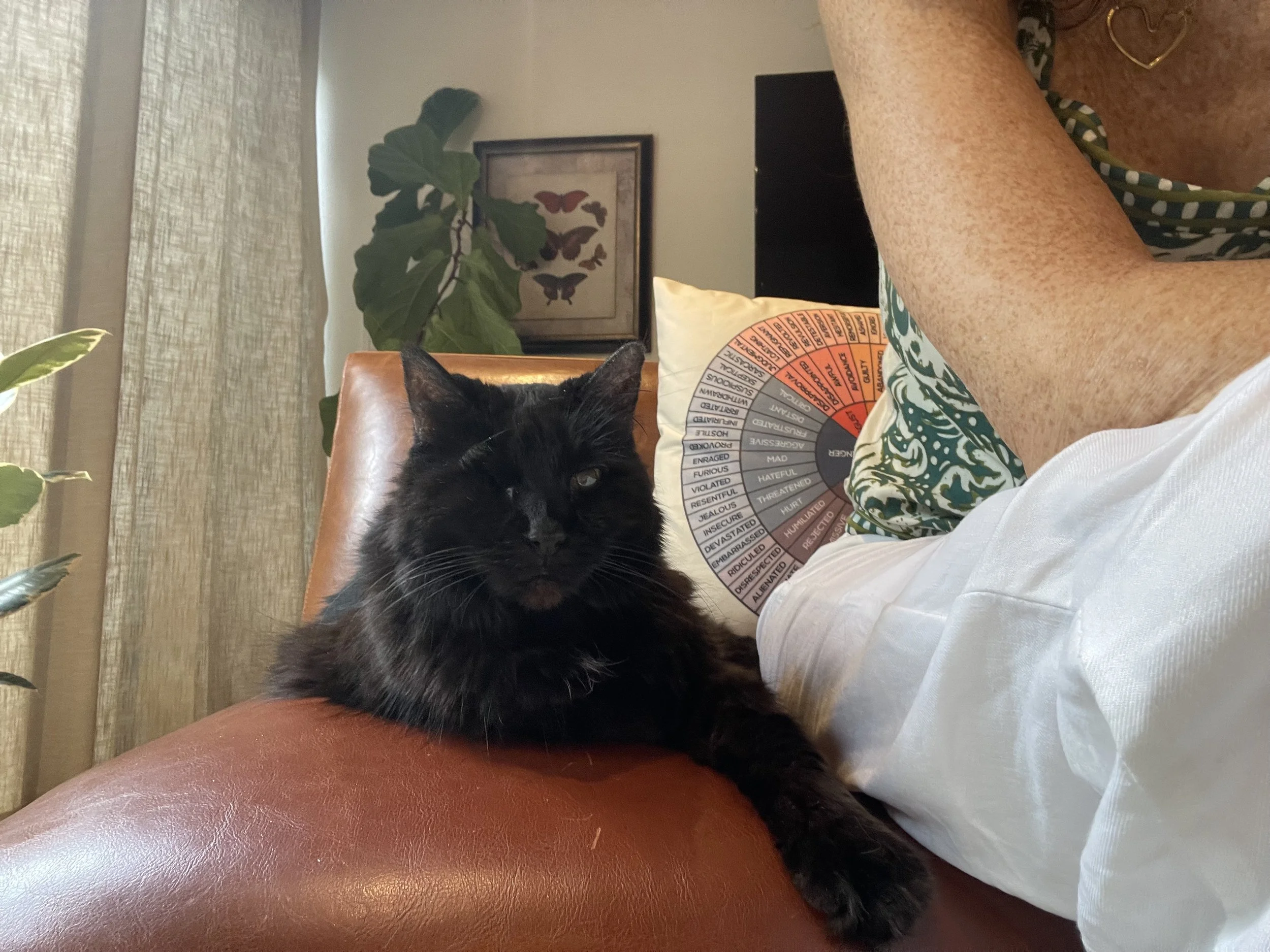
Izzy relaxing comfortably in session, remembered for his calm and steady presence.
When Losing a Pet Hurts This Much: Understanding Attachment and Pet Loss
For a long time, I knew this loss was coming.
My cat, Izzy, was 20 years old, and for years I lived with the awareness that one day I would have to say goodbye to him. There is a particular kind of grief in loving an aging animal—the simultaneous gratitude for more time and the dread of knowing that time is limited.
In some ways, I had been preparing for his death for a long time. I was living inside anticipatory grief.
And yet, when it finally came, I knew there is no real way to prepare for the absence of a being who has quietly woven themselves into the fabric of your daily life.
Izzy was not only part of my family,, but he was part of my work. Many of my clients knew him as a quiet presence during sessions—nearby, sleeping peacefully, occasionally wandering through or “hunting” toys. Over the years, he became part of the atmosphere of safety and familiarity that existed in the room.
His presence was so ordinary that I didn't always notice how much it mattered.
Until it wasn't there anymore.
That is one of the things about pet loss that can be difficult to explain to people who haven't experienced it.
You aren't simply losing a pet. You are losing a relationship.
Why does losing a pet hurt so much?
For many people, a pet becomes woven into the emotional fabric of everyday life.
They may be the first one you see in the morning and the last one you see at night. They may sit beside you while you work, greet you when you come home, sleep next to you, follow you from room to room, or curl up against you when you're having a difficult day.
They are there through ordinary days, heartbreak, illness, loneliness, anxiety, and change.
And unlike many human relationships, animals often offer something remarkably consistent:
presence without judgment, expectation, or the need for us to be different than we are.
They don't need us to explain ourselves.
They don't care whether we've had a productive day.
They don't ask us to perform.
They simply come close.
Over time, that relationship becomes part of our nervous system, our routines, and our sense of home.
This is attachment.
Attachment isn't limited to human relationships. We can form deep attachment bonds with animals who provide companionship, comfort, safety, connection, and a sense of belonging.
If you’ve experienced attachment wounds or have learned to be especially attuned to relationships and connection, the loss of a beloved pet can sometimes touch even deeper layers of grief.
For some people, a pet may be one of the most consistent sources of emotional connection and safety in their lives.
So when that relationship ends, the loss can be profound.
The grief is emotional—but it is also physical
One of the reasons pet loss can feel so overwhelming is that your brain and body have learned the presence of your companion.
You know their sounds.
Their movements.
Their routines.
The weight of them beside you.
The particular way they look at you.
Where they sleep.
When they expect to be fed.
Where they like to sit.
Your nervous system has incorporated these patterns into everyday life.
So after they die, you may find yourself instinctively looking toward their favorite place.
You may think you hear them.
You may reach down to pet them.
You may wake up and, for a moment, expect them to be there.
And then reality catches up.
That moment can feel like being reminded of the loss over and over again.
The grief isn't only in your thoughts.
It can live in your body.
It is the empty space on the couch.
The missing sound in the house.
The quiet where there used to be movement.
The moment you instinctively look for them before remembering they are gone.
This is why pet loss can feel so visceral.
Your mind understands the loss before your body has fully learned the absence.
And then there is the grief that gets minimized
There is another layer that can make pet loss especially difficult:
People don't always recognize it as grief.
Someone may say:
“Are you getting another one?”
“At least they lived a long life.”
“It was just a pet.”
“You can always get another dog.”
“You knew this was coming.”
“You’re pet is no longer suffering.”
Most people mean well.
But these comments can unintentionally communicate that your grief should be smaller.
And sometimes we begin doing the minimizing ourselves.
We may wonder:
Why am I still crying?
Why does this hurt this much?
Shouldn't I be doing better by now?
Why can't I just accept it?
You may even feel embarrassed by the intensity of your grief when other people seem to expect you to move on quickly.
This is sometimes called disenfranchised grief—grief that isn't fully recognized, supported, or socially validated.
And when grief isn't validated, we can end up grieving the loss while simultaneously questioning whether we're allowed to grieve it at all.
But attachment is attachment.
Love is love.
There is no “small” grief simply because the being you lost had four legs instead of two.
You may be grieving more than the death itself
Grief isn't only about what happened in the moment of death.
You're grieving everything that existed around the relationship.
The routines.
The companionship.
The future you imagined together.
The ordinary moments you assumed would continue.
You may even be grieving a version of your own life that existed because your pet was in it.
This can be especially painful when the loss follows a long illness or aging.
There may be relief that your companion is no longer suffering.
There may be gratitude that you had more time.
There may be guilt about decisions you had to make.
There may be exhaustion from caregiving.
There may be sadness about what you knew was coming.
And there may be love so enormous that it is difficult to know where to put it once the relationship changes.
All of those feelings can coexist.
Knowing it was coming doesn't mean you were prepared
This is something I have experienced personally with Izzy.
When an animal has been aging for years, there can be a kind of anticipatory grief—a gradual awareness that the relationship will eventually end.
You notice the changes.
You begin thinking about how much time might be left.
You may find yourself appreciating ordinary moments more intensely because you know they are finite.
In some ways, you are grieving before the death occurs.
And yet, anticipatory grief doesn't eliminate the pain of the actual loss.
Knowing something is coming is not the same as experiencing its absence.
You can understand intellectually that your companion will die someday and still be completely unprepared for what it feels like to live in a world where they are no longer there.
Because you weren't only preparing for a death.
You were preparing for the loss of a presence.
So how do you get through it?
There is no single correct way to grieve a pet.
And there is no timeline you have to follow.
But there are ways to give yourself more compassion while you move through the loss.
Let the loss be real
You don't have to minimize it because someone else might not understand.
If this was an important relationship, allow yourself to acknowledge that.
You lost someone you loved.
That matters.
Talk about them
Say their name.
Tell the stories.
Look at the photographs.
Remember their funny habits, their favorite places, the things that made them uniquely themselves.
Sharing memories doesn't mean you are refusing to move forward.
Sometimes remembering is part of helping the mind integrate the reality of the loss.
Let yourself miss the ordinary things
Sometimes what we miss most isn't a big moment.
It's the tiny things.
The sound of their paws.
The way they slept.
The way they greeted you.
The place they always curled up.
The sound they made when they wanted something.
The way they looked at you.
The little rituals that seemed insignificant while they were happening but became part of the architecture of your life.
Those details were part of the relationship, too.
Create a ritual
A ritual can help give shape to a loss that otherwise feels difficult to comprehend.
You might create a memorial, make a photo book, plant something in their memory, keep their collar or another meaningful object somewhere special, write them a letter, or create a small memory box.
You don't have to “let go” in order to heal.
You can create a way to remember.
Take care of your nervous system
Grief is emotional, but it is also physical.
You may feel exhausted, restless, disconnected, heavy, anxious, or unable to settle.
Gentle movement, eating regularly, getting outside, resting, breathing slowly, and allowing yourself moments of comfort can help support your body while it processes the loss.
You don't have to make yourself feel better.
Sometimes the goal is simply to help yourself feel supported while you hurt.
Be gentle with guilt
Pet loss can bring enormous amounts of guilt.
Did I notice something soon enough?
Did I make the right decision?
Did I wait too long?
Should I have done more?
Could I have prevented this?
These questions often come from love—and from the mind's desperate wish that there had been something more we could have done.
But loving someone does not mean being able to control the outcome of their life.
You made decisions with the information, resources, and love you had at the time.
Sometimes the kindest thing you can say to yourself is:
I did the best I could because I loved them.
Healing doesn't mean forgetting
You may have a good day and then suddenly fall apart the next morning.
You may think you're doing better until you find a toy, hear a familiar sound, or realize you haven't seen them in their usual spot.
This doesn't necessarily mean you're going backward.
Grief isn't linear.
It comes in waves.
At first, the waves may feel constant and overwhelming. Over time, there may be more space between them.
Eventually, remembering them may begin to bring both sadness and warmth.
The pain may never disappear completely because the love doesn't disappear completely.
And that isn't failure.
That is attachment.
You don't have to “get over” someone you loved
Perhaps one of the most compassionate ways to think about pet loss is this:
You don't need to get over your pet. You need to learn how to live with the love and the loss at the same time.
The empty space where they used to be may always matter.
That is because they mattered.
I have felt the loss of Izzy deeply—not only as grief, but as the absence of a steady companion who shared both my personal life and my clinical space for 20 years.
There is a particular kind of silence that follows the loss of a companion who has been part of your everyday world for so long.
And I am learning, as I grieve, that the depth of that silence reflects the depth of the bond. The depth of this pain reflects the depth of our connection.
If you are grieving a pet right now, there is nothing ridiculous or excessive about your pain.
Sometimes the loss of a pet can also awaken older experiences of loss, abandonment, loneliness, or feeling alone in your pain. If your grief feels especially overwhelming or difficult to process, therapy can provide a space where that loss doesn't have to be minimized.
You are not grieving “just an animal.”
You are grieving a relationship.
A daily presence.
A source of comfort.
A familiar rhythm.
A sense of home.
A being who knew you and accompanied you through a portion of your life.
It hurts because you loved them.
And eventually, the goal isn't to stop loving them.
It is to be able to carry that love differently—to remember them with tenderness, to make room for the sadness, and to allow the relationship to become part of the story you carry forward.
These bonds matter.
And grieving them is deeply human.
Sometimes pet loss can bring up more than the immediate grief. It can touch older experiences of loss, abandonment, loneliness, attachment, or feeling alone in your pain. If your grief feels especially overwhelming or difficult to process, therapy can provide a space where that loss doesn't have to be minimized.